



Operational Safety and Occupational Safety
Occupational Injuries
At FENC, the end game for occupational safety and health is “zero occupational incidents.” The Company values the safety and health of each and every employee, protecting them by raising their awareness and understanding through risk assessment and identification; outreach campaigns and public notice; pre-shift toolbox talks; safety and health month programs and activities. A total of 260 near-misses were recorded during the reporting year. Among them, 102 are fall-related with low hazard awareness as the main factor. In the unfortunate event of occupational disasters, immediate emergency and rescue actions are taken. The following improvement procedures are applicable to all production sites:
.png)
All improvements shall be completed within two months, and hardware improvements involving construction contracts should be completed within six months. A total of 54 occupational injuries were recorded at FENC sites in 2025, representing a 100% increase from the previous year statistically. The main contributing factor is the gas explosion that occurred at Hsinpu Chemical Fiber Plant, which injured 19 employees and caused the unfortunate death of two employees. FENC provided all assistance possible to the families of the deceased with funeral arrangements and compensation that exceeds the regulatory requirement. Employees suffering injuries received comprehensive medical care, 24-hour care and support as well as psychological first aid. A probe was conducted to examine the incident with the most stringent standards. TÜV Rheinland Taiwan was commissioned to conduct a professional third-party process safety audit and root cause analysis, which served as the anchor for the overhaul that followed. Additionally, a CCTV+AI smoke detection system for heat transfer fluids has been incorporated to enhance real-time early warning. For details regarding this incident, please refer to Special Report: Response and Prevention Mechanism in the Wake of the Gas Explosion Incident at Hsinpu Chemical Fiber Plant.
Another unfortunate incident was recorded at OTIZ during the reporting year. An employee was caught in the roller while cleaning textile equipment and sadly suffocated. To keep tragedies such as this from happening in the future, OTIZ has made sure the necessary improvements are completed, adding an interlock device for the stop rope tensioner/door drive and replacing manual operation with automated spray cleaning to avoid risking personnel safety. The risk identification protocol and standard operating procedures have also been revised, and OTIZ is strengthening organizational safety training and conducting thorough inspections to identify any hazards.
Among the occupational injuries, “others (falls)” ranks the highest with 13 cases recorded, followed by “cuts/abrasions/punctures” with 11 cases. The main cause is low hazard awareness among staff. “Explosions” tied as the second highest category with 11 cases, which is the result of the gas explosion at Hsinpu Chemical Fiber Plant. Regarding these occupational injuries, investigations have been completed in accordance with the established procedures, and improvement measures have been implemented. To prevent occupational incidents, preventive measures targeting the causes have been proposed as follows.
- Construction control (hardware improvement)
• The protective guards, such as mesh guards and guardrails, for rotating and moving components must be thoroughly examined to ensure compliance with safety regulations.
• Photoelectric sensors or interlocking devices are installed in danger zones to automatically stop the machine operation when workers approach within a close distance. - Operating procedures and management measures
• Lockout and tagout: Prior to any repair, adjustment or cleaning operation, the power source of the equipment must be shut off and locked to keep the equipment from being switched on accidentally.
• Risk assessment and zoned management: Danger zones are labeled with demarcations such as the red warning tape with access restricted to authorized personnel only. For highly hazardous operations, the two-person rule is implemented. - Automation and technology upgrade
• Smart visual recognition is incorporated to monitor equipment and automatically send warnings or messages when irregularities occur.
• Manual labor is replaced by robotic arms for high-risk operations, such as material feeding or handling. - Personnel training and behavior-based management
• Strengthening safety education: Safety training for machine operation is conducted on a regular basis, including emergency drills and case analysis. New employees must pass operational assessments before they can proceed independently.
• Standardizing PPE: Loose-fitting clothing and items such as long necklaces are prohibited. Work clothing with a proper fit and non-slip shoes are provided, and cut-resistant gloves are prepared under certain circumstances provided that the gloves do not pose the risk of being caught in/between the machine.
Statistics on Occupational Injury in 2025
.png)
A total of nine occupational incidents involving contractors at FENC’s production and operation sites were recorded in 2025, which is 44% higher than the five cases recorded in 2024. Crash-related incidents rank the highest with three cases recorded. To keep this type of incidents from happening, the following countermeasures have been proposed:
- Unauthorized personnel are not permitted in the vehicle operation zone.
- Reinforced awareness training is provided to contractor employees, and personnel entering the restricted area must wear reflective safety vests to increase visibility.
- Enhanced training is provided to contractor employees and crash incidents are included as case studies during training.
2025 Process Safety Incident Statistics for Employees and Contractors
Petrochemical | Polyester | Textile | Total | |
Process Safety Incidents Counts (PSIC) (Total) | 5 | 8 | 7 | 20 |
Tier 1 Process Safety Incidents Counts (PSIC) | 0 | 1 | 1 | 2 |
Total Severity | 0 | 9 | 57 | 66 |
Process Safety Total Incident Rate (PSTIR) | 0 | 0.01 | 0.01 | 0.01 |
Process Safety Incident Severity Rate (PSISR) | 0 | 0.55 | 0.05 | 0.24 |
| Note: 1. Statistics cover 100% production sites in this report. Beginning in 2025, disclosures from PFEM have been included. 2. Total work hours of employees and contractors are 54,171,748 hours in 2025, not including the Corporate Management. 3. Process Safety Total Incident Rate (PSTIR) =(tier 1 process safety incidents counts x 200,000) / total work hours 4. Process Safety Incident Severity Rate (PSISR) =(total severity points of tier 1 process safety incidents x 200,000) / total work hours |
The 2025 statistics pertaining to occupational injuries at FENC production sites have been analyzed and compared by industry with the 2024 occupational disabling injury frequency rate and disabling injury severity rate compiled by the Occupational Safety and Health Administration in Taiwan. Both rates from FENC’s Petrochemical and Textile Businesses are lower than those from the industry peers. A disabling injury severity rate higher than those from industry counterparts is observed in the Polyester Business, which is the result of the gas explosion incident at Hsinpu Chemical Fiber Plant, which caused fatalities and lost hours among injured employees.
Comparison Between FENC and Nationwide Statistics on Occupational Injuries
Petrochemical Industry | Polyester Industry | Textile Industry | ||||
FR | SR | FR | SR | FR | SR | |
Statistics from Taiwan OSHA | 0.29 | 8 | 1.99 | 49 | 2.05 | 159 |
Statistics from FENC | 0 | 0 | 2.16 | 1,198 | 0.88 | 3 |
| Note: 1. Disability injury frequency rate (FR) = total number of disabling injuries ×1,000,000 ÷ total manhours worked. 2. Disability injury severity rate (SR) = number of injured days off work × 1,000,000 ÷ total manhours worked. 3. FENC data is compared against the 2024 statistics for the petrochemical, chemical material manufacturing and textile industries from Occupational Safety and Health Administration, Ministry of Labor. |
Saddened deeply by the unfortunate occupational incidents that caused harm to the employees, FENC takes these lessons and its commitment to safety and health management to heart. Turning grief into motivation, the Company has adopted aggressive measures to implement hazard identification and risk control while perfecting the operating procedures and requiring compliance from all employees. These are considered top priorities for occupational safety and health management, which will help FENC keep incidents such as these from ever happening again.
↪More information:Calculation Formulas and Definitions of Indicators Related to Occupational Injury Statistics ,Statistics on Empolyees’ Occupational Injury, Contractor’s Occupational Injury at Production Sites
Promoting Occupational Safety and Health with Stakeholders
1. Non-Profit Safety and Health Promotion-Kuansin E Family
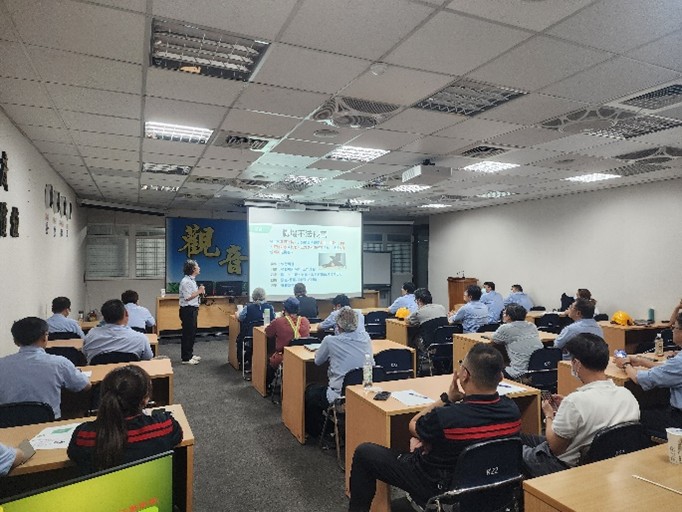
In 2017, Kuanyin Chemical Fiber Plant joined the Labor Safety and Health Family Registry, a coaching program launched by the Office of Labor Inspection of Taoyuan City Government, proactively serving as a core leader. To scale the program and demonstrate its commitment to safety and health management, the plant established another safety and health family, "Wei Nin Ping An," in 2023. Acting as the core leader of this new family, Kuanyin Chemical Fiber Plant continues to leverage its scale to mentor smaller enterprises, collaboratively fostering workplace safety awareness and a robust safety culture to elevate the safety and health knowledge of employees, contractors, and the general public. In 2025, its outstanding efforts were recognized with the "Award of Excellence" at the Safety and Health Family Performance Reward and Selection Competition organized by the Taoyuan City Government.
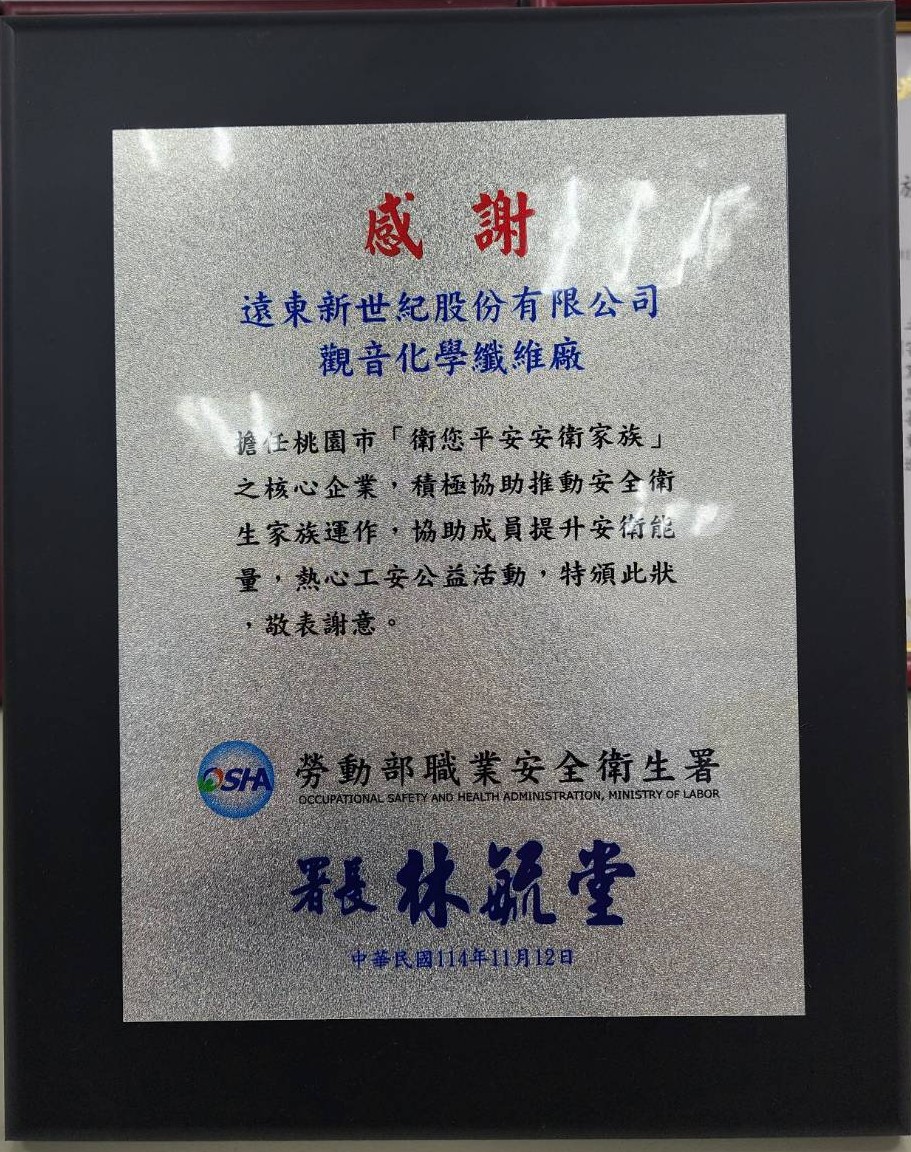
⇥Award of Excellence–Kuansin E Family (Chinese)
Its efforts in 2025 include the following:
- Kuansin E Family held pre-construction meetings, occupational safety and health outreach and briefings regarding labor inspection guidelines. A total of four training sessions were also offered to discuss contractor management, hazard prevention during hazardous operations and case studies on occupational incidents. The sessions drew 98 participants, including plant supervisors, safety and health management personnel, junior staff and members within Kuansin E Family.
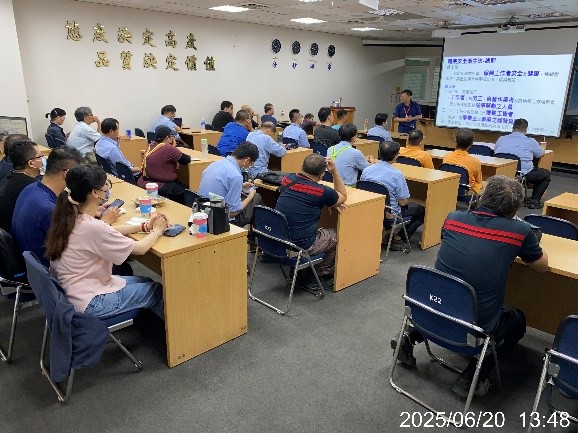
- Kuanyin Chemical Fiber Plant actively assists its family partners (contractors) in diagnosing Occupational Health and Safety (OHS) issues and formulating corrective action plans. In 2025, 29 diagnostic recommendations were proposed, all of which have been fully resolved, achieving a 100% improvement rate. Compared to 2024, the number of recommendations decreased slightly, and contractors with identified deficiencies demonstrated a strong commitment to complying with OHS improvement measures. This indicates that the implementation of the Safety and Health Family program has effectively elevated personnel safety awareness. By proactively leveraging self-management and review mechanisms, we are collaboratively fostering a sound OHS environment and cultivating a robust workplace safety culture.
Performance of Safety and Health Family Program
.png)